The Ghost in the Machine: Why the Dead Internet Needs a Living Voice
I was looking at my analytics the other day and had a chilling thought: Is anyone actually reading this, or am I just feeding a series of LLM crawlers? It feels like the internet...

Published by
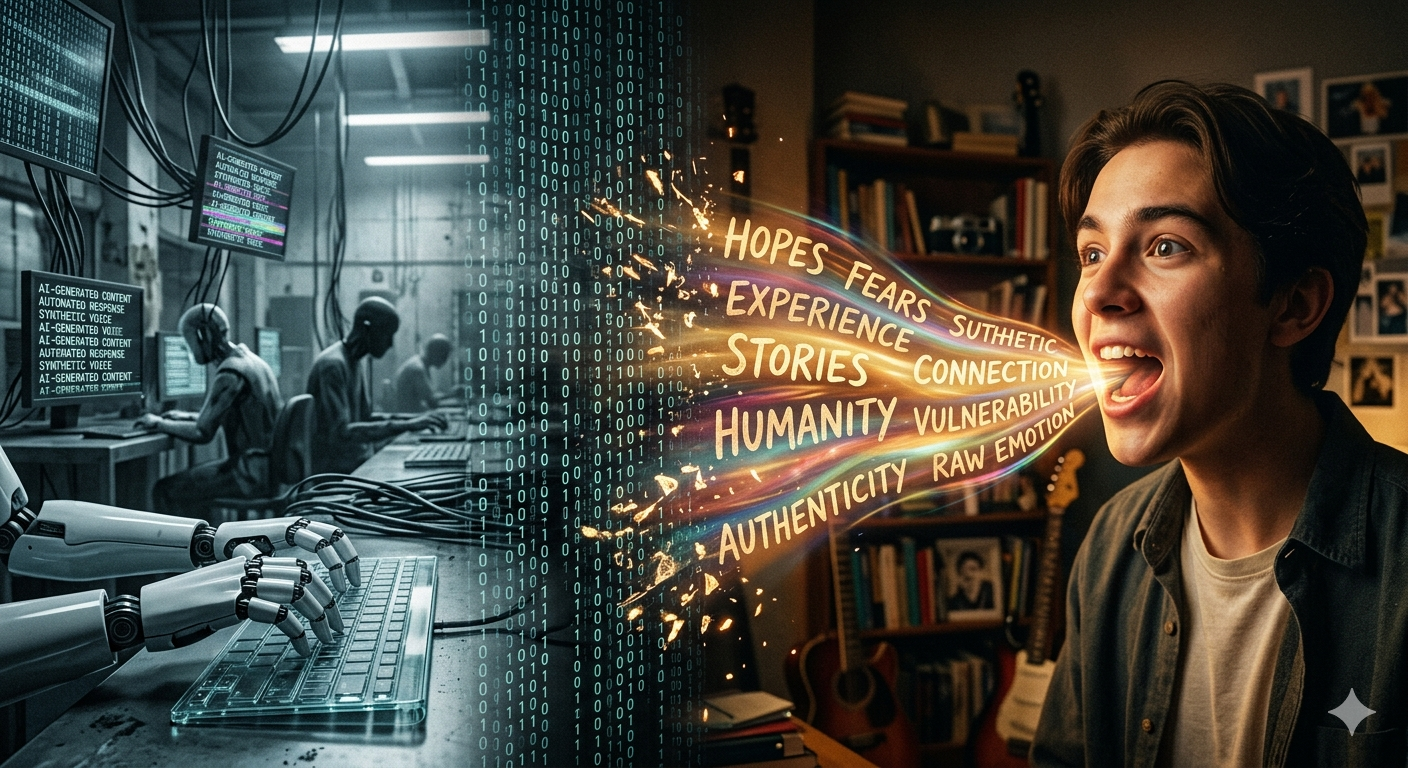
I was looking at my analytics the other day and had a chilling thought: Is anyone actually reading this, or am I just feeding a series of LLM crawlers?
It feels like the internet has become a closed loop. AI models scrape human blogs to train themselves, then they spit out summaries so people don't have to visit the blogs, and then other AI bots scrape those summaries to post "content" on social media. It’s a hall of mirrors. We are heavy users of AI I use it to help me code, to structure my thoughts, to automate the boring stuff but there’s this nagging question: Are we losing the "human" in the process?
The Rise of the "Synthetic Web"
By now, we’ve all seen it. You search for a product review and find ten websites that look identical. They use the same stock photos, the same "Pros and Cons" generated from a spec sheet, and that strangely neutral, "blandified" tone that characterizes most AI writing.
This is the "Dead Internet." It’s an internet of high volume and zero soul. It’s technically "correct," but it’s hollow. It can tell you the DPI of a mouse, but it can’t tell you how the plastic feels against your palm after six hours of a DevOps shift. It can list the ingredients of a recipe, but it doesn't know the frustration of realizing your avocado salad was in the freezer instead of the fridge.
Why We Still Crave the Human Element
So, is anyone still reading? Yes. In fact, they are reading more than ever—they’re just being more selective.
In a world of infinite AI-generated answers, trust has become the rarest currency. When you’re making a real decision—like buying a keyboard that needs to work for both a gamer and a family member with low vision—an LLM can give you a list. But a human can give you a recommendation.
There is a massive difference between information and experience.
Information is: "The Keychron V1 has hot-swappable switches."
Experience is: "I swapped these caps for my father-in-law because he couldn't see the standard legends, and seeing him finally type without squinting made the ten minutes of tinkering worth it."
AI cannot have "worth it" moments. It cannot have stakes. It doesn't have a family to travel with or a neighbor's dog to walk. When we read a blog, we aren't just looking for data; we are looking for a proxy—someone who has stood where we are standing and can tell us the truth, quirks and all.
The "AI-Free" Premium
We are entering an era where "Human-Written" will be a luxury label, like "Organic" or "Handmade."
As a DevOps pro, I see the efficiency of automation every day. I love that I can spin up a staging block in Nginx with a single script. But if my entire life becomes a script, what’s the point? If my blog is just a collection of keywords designed to please an algorithm, I’m just a ghost in the machine.
The blogs that will survive 2026 and beyond are the ones that lean into their humanity. They are the ones that:
Share the Failures: AI doesn't make mistakes; it "hallucinates." Humans make mistakes, and we learn from them. Sharing the "Mistakes to Lessons" is something a bot can't authentically do.
Take a Stand: AI is programmed to be neutral. It’s "balanced" to a fault. A human can say, "I hate this popular product, and here is exactly why it frustrated me."
Provide Context: A bot knows the weather in Thailand; it doesn't know the logistical nightmare of moving 11 family members through Bangkok heat while trying to find a van that fits everyone.
Is it Good or Bad?
You asked if this development is good or bad. The truth is, it’s both.
It’s bad because it makes finding the truth harder. It creates a "noise" floor that is exhausting to navigate. It forces creators like us to work twice as hard just to prove we’re real.
But it’s good because it’s a filter. The "content farms" that used to dominate the web are being replaced by AI. That sounds scary, but those farms were never "human" to begin with they were just people acting like bots. Now that the actual bots have taken over that tier, the real humans are being pushed to find their actual voices.
The New Playbook for the Living Internet
If you’re a creator, the goal isn't to beat the AI at being a library. You will lose. The goal is to beat the AI at being a person.
When I write about featherab.com, or my journey with affiliate marketing, I’m not just trying to rank for keywords. I’m trying to document a journey. I’m talking to the person who is also struggling with an Amazon account closure, or the person who is trying to balance a high-tech career with a high-touch family life.
So, to the person reading this if you are a person don’t stop looking for the human voice. Don’t settle for the summary. Click the link. Read the "About" page. Leave a comment that an LLM couldn't possibly understand.
The internet isn't dead yet. It’s just waiting for us to stop acting like algorithms and start acting like people again.


Discussion
Reader comments
0 approved